

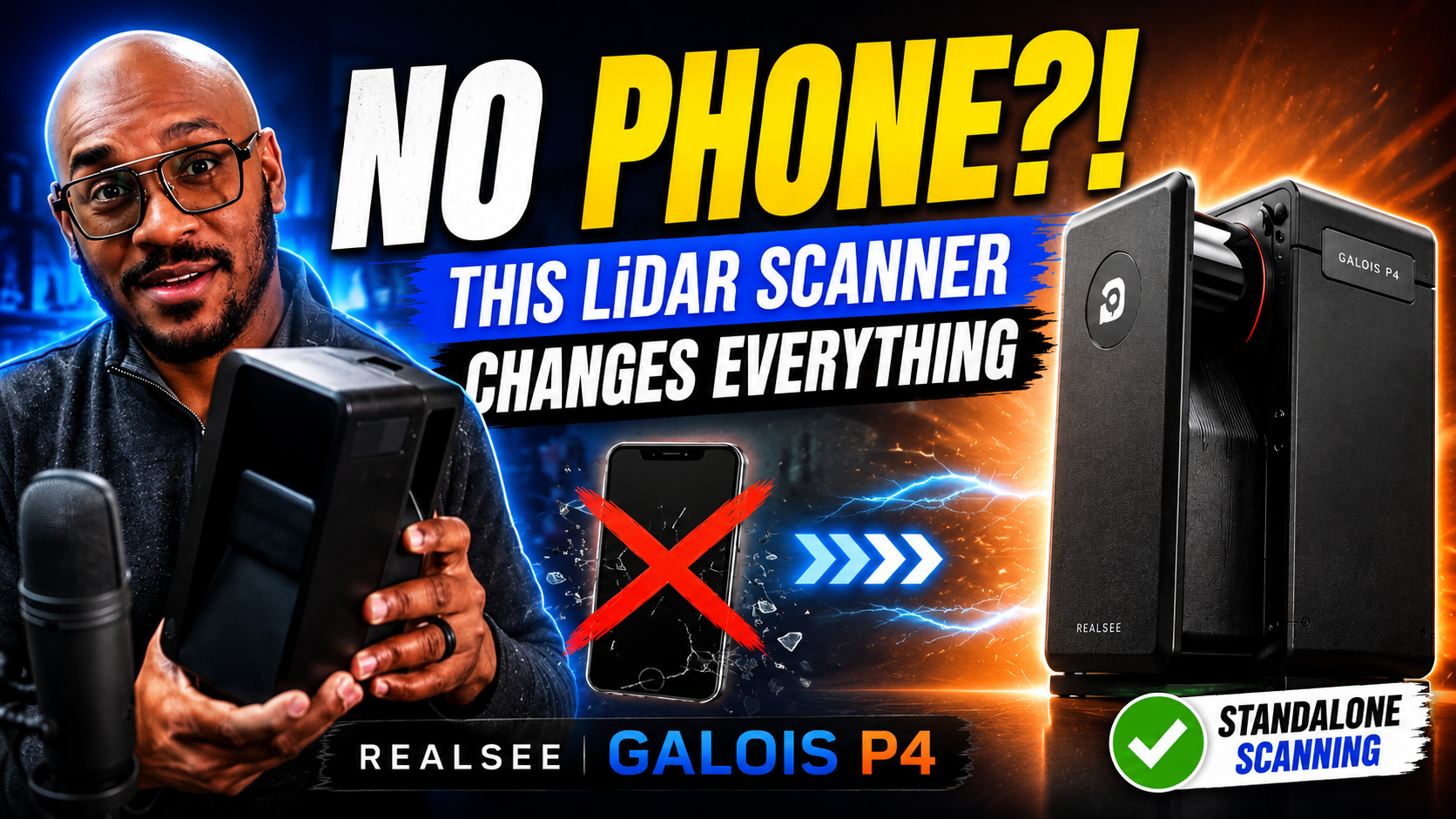
This video provides a detailed, professional review of the Realsee Galois P4 lidar scanner. The reviewer, Edward, tests the device extensively in real-world scenarios, including under a Texas highway overpass, a commercial storefront, a manufactured home, and a four-bedroom house.
He approaches the device with years of experience in BIM and CAD workflows, emphasizing practical usability for architecture, engineering, and construction (AEC) professionals.
The review highlights the P4’s significant technical improvements and workflow advantages over its predecessor, the M2, situating it within the current lidar scanner market and offering insights into its value proposition for different user groups.
Key Technical Specifications and Comparisons
Physical and Usability Improvements
-
Form factor: The P4 retains the familiar size and weight of the M2, making it comfortable and recognizable to existing users.
-
Color: Shifts from cool gray (M2) to all black.
-
Lidar Sensor Housing: Slightly larger in P4, with an extra aperture contributing to a much higher point capture rate.
-
Tripod Mount: Introduces a quick-release feature improving repositioning efficiency across long scanning sessions.
-
Battery: Transitioned from one large, long-lasting battery (M2) to 2 smaller batteries enabling hot swapping for continuous workday use.
-
Storage and Kit Organization: Comes with hard cases for both device and tripod, fitting conveniently into a branded backpack—ideal for professionals needing portability and organization.
-
Touchscreen Display: A newly added touchscreen significantly changes the on-site workflow by allowing standalone operation without the need for an auxiliary device.
Performance and Field Testing Highlights
-
Range and Accuracy:
-
The P4 demonstrated a usable point cloud radius of 51 m (170 ft)** from a single scan station, far exceeding the M2’s 25 m range.
-
Accuracy improved from a ±20 mm margin (M2) to ±10 mm, reducing design discrepancies and enhancing as-built documentation accuracy for BIM workflows.

-
-
Point Density:
-
The P4’s output of 125,600 points per second is nearly seven times greater than the M2’s 18,600, permitting richer and denser data, especially when multiple scan stations overlap.
-
-
Image Quality:
-
The P4 delivers sharper, richer panoramas at 24K clarity with a 47 MP sensor, compared to the M2’s 16K and 134 MP photos.
-
Enhanced HDR capability manages difficult lighting (e.g., sharp contrasts between bright sun and shade) better than typical cameras.
-
The addition of multi-spectral sensors provides greater detail retention and color accuracy.
-
-
High-Fidelity Mode:
-
Offers crisper geometry and images but increases individual scan time from 16 seconds (standard) to approximately 70 seconds.
-
Recommended for high-quality deliverables like renovation documentation or condition reports.
-
-
Narrow Space Handling:
-
A fisheye lens with a 213.25° vertical field of view efficiently captures narrow, tall spaces (a 3 ft 9 in closet with an 8 ft high window) with minimal distortion, outperforming the M2’s narrower vertical view.
-
Groundbreaking Feature: Standalone, Blind Scan Capture
-
The P4 enables fully standalone scanning without a phone or tablet connected, a rare capability at this price point.
-
Operation:
-
Press and hold the touchscreen for 5 seconds to initiate a 16-second scan.
-
The device automatically saves data to the onboard SSD.
-
User moves between scan stations blindly, repeating the process without requiring live preview or device pairing.
-
-
Field Test:
-
Conducted a full multi-room scan of an 18-scan station four-bedroom home without any live feedback or phone connection.
-
Importing scans into the Realsee app afterward yielded 17 stations automatically aligned; one required manual adjustment.
-
Demonstrated seamless integration of blind scans with phone-assisted scanning in the same project, allowing ongoing work flexibility.
-
Advantages compared to competitors:
Software and Ecosystem Features
-
Realsee platform offers a pay-as-you-go business model with no mandatory monthly subscription, ideal for intermittent users.
-
Automated cloud processing includes:
-
High-resolution stitching
-
Point cloud alignment
-
Deliverable generation: virtual 3D tours, E57/PLY point cloud files for BIM use, OBJ/FBX for visualization, panoramas, and automatically generated CAD floor plans.
-
-
The auto-generated CAD floor plans are approximately 90% ready for immediate use, significantly simplifying design workflows compared to manual vectorizing.
-
The system supports continued project work across multiple days or operators, enhancing scalability for commercial jobs.
Practical Recommendations and Use Cases
-
Realsee M2 remains ideal for:
-
Residential and light commercial projects
-
Users prioritizing affordability ($5,500 standard kit, with exclusive offers lowering it to $5,000)
-
Scans within a 25 m range
-
-
Realsee P4 targets professional users whose project scope demands:
-
Extended scanning range (up to 100 m)
-
Higher accuracy (±10 mm)
-
Much denser point clouds for complex multi-room or infrastructure projects
-
Mobility and battery flexibility for full-day site work
-
Standalone scanning workflow without dependency on external devices
-
-
Users scanning large commercial, infrastructure, or complex multi-residential properties will benefit most from the P4’s capabilities.
Key Insights and Conclusions
-
The Realsee Galois P4 is a game-changing lidar scanner in the $7,499 price segment, delivering top-tier range, accuracy, and point density.
-
The touchscreen-enabled standalone “blind scanning” mode represents a major workflow advancement, reducing reliance on phones or tablets and handling full-site captures efficiently.
-
The combination of improved hardware, software ecosystem, and flexible pricing creates a compelling option for professionals needing scalable, versatile scanning solutions.
-
Compared to high-end competitors like the Leica BLK360 G2, the P4 offers similar standalone capabilities at less than a quarter of the price.
-
For lighter residential and commercial work, the M2 remains cost-effective with excellent features.
-
The reviewer's practical field test validates the P4’s claims, showcasing the robust application in challenging environments, including narrow interiors and demanding lighting.

Additional Notes
-
Full demonstrations and workflow details for importing Realsee scans into CAD and BIM software are available in a separate linked tutorial.
-
Realsee’s partnership with Clayton Homes enabled practical testing inside a manufactured home, highlighting the P4’s ability to manage tight and detailed spaces.
-
The reviewer strongly recommends new users develop an intentional scan path when using the blind mode due to the lack of real-time preview; however, it is not technically difficult with experience.
This comprehensive evaluation positions the Realsee Galois P4 as a professional-grade, cost-effective lidar scanner that brings advanced features and flexible workflows commonly found only in much more expensive systems to a broader AEC user base.